
How to Build a Complete B2B Lead Generation Funnel That Converts (2025)
Step-by-step guide to building a B2B lead generation funnel from scratch. Includes awareness, consideration, conversion strategies, automation, and metrics that matter.
Vincent
Founder & Lead Generation Expert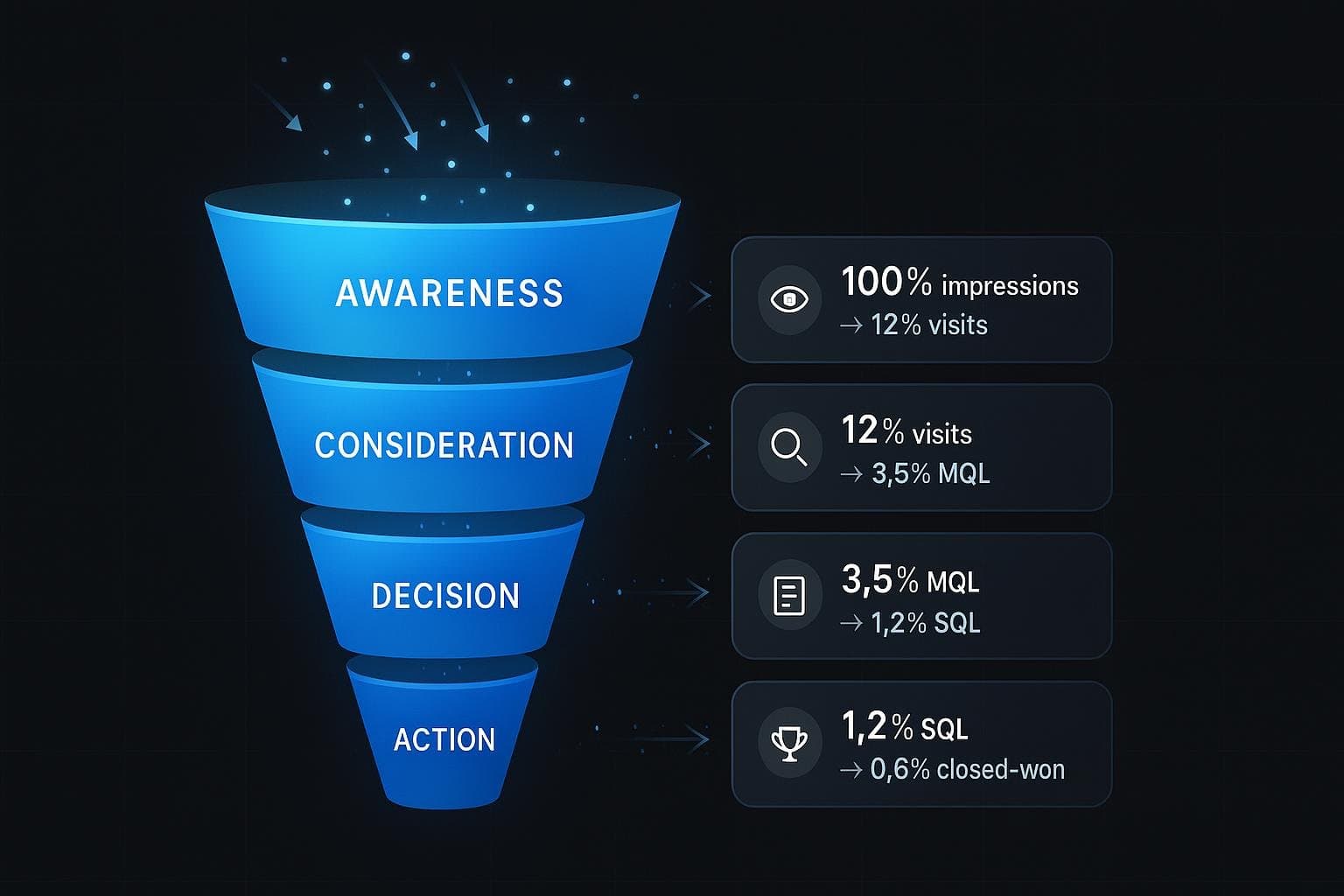
How to Build a Complete B2B Lead Generation Funnel That Converts (2025)
Most B2B companies fail at lead generation because they focus on tactics without building a proper funnel. They run ads, send cold emails, or post on LinkedIn—but don't connect these efforts into a cohesive system that moves prospects from awareness to paying customers.
A proper lead generation funnel isn't optional—it's the difference between 5% and 25% conversion rates.
This guide shows you how to build a complete B2B lead generation funnel from scratch, with specific tactics for each stage, automation strategies, and metrics that actually matter.
What is a B2B Lead Generation Funnel?
A lead generation funnel is the path prospects take from first hearing about your company to becoming a customer. Unlike B2C funnels (which might take hours or days), B2B funnels typically span 30-180 days and involve multiple decision-makers.
The 5 Stages of a B2B Lead Funnel
Stage 1: Awareness (Top of Funnel)
- Prospect realizes they have a problem
- Discovers your solution exists
- Learns what you do
- Goal: Capture attention and contact info
Stage 2: Interest (Upper-Middle Funnel)
- Prospect researches solutions
- Compares options
- Engages with your content
- Goal: Build credibility and stay top-of-mind
Stage 3: Consideration (Middle Funnel)
- Prospect evaluates specific vendors
- Requests demos or proposals
- Checks references
- Goal: Demonstrate value and differentiation
Stage 4: Intent (Lower Funnel)
- Prospect decides to buy
- Negotiates terms
- Reviews contracts
- Goal: Close the deal
Stage 5: Customer (Retention)
- Onboards successfully
- Uses product/service
- Considers renewal/upsell
- Goal: Maximize LTV and get referrals
Why Most B2B Funnels Fail
Common mistakes:
- No clear stages: Treating all leads the same
- Broken handoffs: Marketing doesn't align with sales
- Leaky funnel: Losing 80% of leads between stages
- No automation: Manual processes that don't scale
- Wrong metrics: Focusing on vanity metrics instead of conversion rates
The cost of a broken funnel:
- €10,000 in ad spend generates 200 leads
- Only 10 become opportunities (95% leak!)
- 2 close as customers (2% conversion)
- Should be 40-50 opportunities and 10-15 customers
Stage 1: Awareness (Top of Funnel)
Objective: Generate 200-500 net-new prospects monthly who match your ICP (Ideal Customer Profile)
Define Your Ideal Customer Profile
Before building awareness campaigns, know exactly who you're targeting.
Firmographic criteria:
- Industry vertical (e.g., B2B SaaS, agencies, e-commerce)
- Company size (10-100 employees sweet spot for most)
- Revenue range (€1M-50M for mid-market)
- Location (your serviceable geography)
- Technology stack (if relevant)
Behavioral criteria:
- Actively hiring for relevant roles
- Recently raised funding
- Expanding to new markets
- Experiencing rapid growth
Pain point criteria:
- Struggling with manual processes
- Losing deals to competitors
- Can't scale current systems
- Compliance/security concerns
Top-of-Funnel Tactics
1. SEO Content Marketing
Strategy: Rank for keywords prospects search when discovering their problem
Process:
- Research high-intent keywords (500-5,000 volume, 20-50 difficulty)
- Create comprehensive guides (3,000-6,000 words)
- Optimize for featured snippets
- Build backlinks from industry sites
- Update content quarterly
Example keywords:
- "How to generate B2B leads"
- "Best CRM for small agencies"
- "Email marketing automation tools"
- "[Your industry] software comparison"
Expected Results
500-2,000 organic visitors/month per article after 6 months
2. Paid Advertising
LinkedIn Ads (Best for B2B):
- Target by job title, company size, industry
- Use sponsored content and InMail
- Budget: €50-100 per lead
- Best for: Enterprise and mid-market
Google Search Ads:
- Target high-intent keywords
- Use negative keywords to reduce waste
- Budget: €30-80 per lead
- Best for: Solution-aware prospects
Retargeting Ads:
- Show ads to website visitors
- Focus on high-value pages (pricing, case studies)
- Budget: €15-40 per lead
- Best for: Nurturing warm traffic
Campaign structure:
Campaign: B2B Lead Gen - LinkedIn
├── Ad Set 1: Marketing Directors at Agencies (50-200 employees)
├── Ad Set 2: Founders at SaaS Companies (10-50 employees)
└── Ad Set 3: Sales Leaders at B2B Companies (100-500 employees)
3. Cold Outreach
Email prospecting:
- Build targeted lists (industry, job title, company size)
- Personalize at scale using variables + AI
- Send 30-50 emails per day per domain
- Expected reply rate: 15-25%
LinkedIn outreach:
- Connect with ICP prospects (50-100 per week)
- Personalized connection requests (reference common ground)
- Follow-up message 3 days after connection
- Expected acceptance rate: 30-40%
Phone prospecting (for high-value accounts):
- Research before calling
- Script key talking points (not a word-for-word script)
- Leave strategic voicemails
- Follow up with email immediately after
4. Content Distribution
Platforms:
- LinkedIn (organic posts 3-5x per week)
- Industry forums (Reddit, Quora, niche communities)
- Guest blogging on industry sites
- Podcast appearances
Content types:
- Thought leadership posts
- Case studies and results
- Industry insights and trends
- Controversial takes (for engagement)
Lead Capture Strategy
Website conversion points:
- Exit-intent popup (last chance to capture)
- Inline forms after 50% scroll
- Gated content (guides, templates, tools)
- Chatbot qualification
Lead magnets that work:
- Industry-specific templates (ROI calculators, checklists)
- Original research reports
- Video training series
- Free tools or assessments
Form optimization:
- Ask for minimal fields initially (name + email + company)
- Progressive profiling on subsequent visits
- Clear value proposition above form
- Privacy assurance messaging
Expected conversion rates:
- Cold traffic (ads): 2-5%
- Warm traffic (organic search): 5-10%
- Hot traffic (retargeting): 10-20%
Stage 2: Interest (Upper-Middle Funnel)
Objective: Nurture 200-500 leads into 40-100 marketing-qualified leads (MQLs)
Lead Scoring Model
Not all leads are equal. Implement scoring to prioritize.
Demographic score (0-50 points):
- Job title match: 20 points (decision-maker)
- Company size match: 15 points (ICP range)
- Industry match: 10 points (target vertical)
- Budget indicators: 5 points (funding, ads, events)
Behavioral score (0-50 points):
- Visited pricing page: 15 points
- Downloaded 2+ resources: 10 points
- Opened 3+ emails: 5 points
- Watched demo video: 10 points
- Returned 3+ times: 10 points
Total score interpretation:
- 80-100: Hot lead → immediate sales outreach
- 60-79: Warm lead → accelerated nurture
- 40-59: Cool lead → standard nurture
- <40: Cold lead → long-term nurture or disqualify
Email Nurture Sequences
Welcome Sequence (Days 1-7)
Day 0: Deliver promised resource + introduce brand Day 2: Share best content piece (most popular blog/guide) Day 4: Case study with specific results Day 7: Invite to demo/consultation
Performance benchmarks:
- Open rate: 40-60% (decreasing through sequence)
- Click rate: 15-25%
- MQL conversion: 10-15%
Educational Nurture (Weeks 2-8)
Weekly cadence: Send 1 valuable email per week
- Week 2: Industry insight or trend
- Week 3: How-to tutorial
- Week 4: Customer success story
- Week 5: Tool or template
- Week 6: Webinar or workshop invite
- Week 7: Comparison guide
- Week 8: Soft pitch with special offer
Segmentation:
- By industry (send industry-specific content)
- By behavior (engaged vs. dormant)
- By lead score (hot leads get sales outreach)
Re-engagement Sequence (For dormant leads)
Trigger: No activity for 60+ days
Day 0: "Still interested in [topic]?" Day 3: Share surprising statistic or news Day 7: Offer something new (webinar, guide) Day 14: Breakup email ("Should we stop reaching out?")
Expected Results
15-20% re-engage
Content Strategy for Interest Stage
Blog content themes:
- "How to" guides (tactical, actionable)
- "Complete guide to" (comprehensive, definitive)
- "vs" comparisons (help them evaluate options)
- Case studies (social proof, results)
Video content:
- Product explainer (2-3 minutes)
- Customer testimonials (1-2 minutes each)
- Founder story (why we built this)
- Industry webinars (30-45 minutes)
Interactive content:
- ROI calculators
- Self-assessment quizzes
- Product configurators
- Product demo or sandbox access
Lead Qualification Criteria (MQL Definition)
A lead becomes MQL when they meet these criteria:
Fit criteria (must have):
- Matches ICP (company size, industry, role)
- Has budget authority or influence
- In serviceable geography
Interest criteria (behavioral signals):
- Engaged with 3+ pieces of content
- Visited pricing or product pages
- Requested info or demo
- Opened 5+ emails with 2+ clicks
Timing criteria:
- Currently evaluating solutions
- Has defined timeline (next 3-6 months)
- Expressed urgency
Stage 3: Consideration (Middle Funnel)
Objective: Convert 40-100 MQLs into 10-25 sales-qualified leads (SQLs)
Sales Development (SDR Process)
Initial contact (within 24 hours of MQL handoff):
- Phone call + email + LinkedIn message
- Reference specific content they engaged with
- Goal: Book discovery call
Email template:
Subject: Quick question about [Company]'s [specific pain point]

Hi [FirstName],

I noticed you downloaded our guide on [topic] and checked out our [feature] page.

Are you currently looking to [desired outcome]?

I helped [similar company] achieve [specific result] in [timeframe].

Worth a 15-minute call this week to see if we can help [Company]?

[Your Name]
Follow-up cadence:
- Day 0: Call + email + LinkedIn
- Day 2: Email with additional value (case study)
- Day 5: Phone call + voicemail
- Day 7: Email with video message
- Day 10: Final email ("closing the loop")
Expected conversion: 25-40% of MQLs book discovery call
Discovery Call Framework
Objectives:
- Understand their situation and pain points
- Qualify fit (budget, authority, need, timeline)
- Demonstrate preliminary value
- Book demo or next meeting
Structure (30 minutes):
Minutes 0-5: Rapport + Agenda
- Thank them for time
- Set expectations
- Get permission to ask questions
Minutes 5-15: Discovery Questions
- What triggered you to look for a solution?
- What's working/not working with current approach?
- What does success look like?
- Who else is involved in decision?
- What's your timeline?
- What's your budget range?
Minutes 15-25: Preliminary Solution
- Reflect back their pain points
- Share how you've solved similar problems
- Mention relevant features
- Share 1-2 brief case studies
Minutes 25-30: Next Steps
- Propose demo or proposal
- Confirm decision-making process
- Set specific next meeting
- Send calendar invite before ending call
Disqualification criteria:
- Budget <€1,000/year (not worth effort)
- No authority or access to decision-maker
- Timeline >12 months (too far out)
- Poor fit for product (better alternatives exist)
Product Demo Best Practices
Before demo:
- Send pre-demo questions to understand needs
- Customize demo to their use case
- Load their industry data (or similar)
- Test all tech (screen share, audio)
Demo structure (45 minutes):
Minutes 0-5: Recap and Agenda
- Summarize discovery call insights
- Preview what you'll cover
- Set expectations
Minutes 5-35: Live Product Demo
- Start with END result (show the value)
- Walk through their specific workflow
- Highlight 3-4 key features that solve their problems
- Pause for questions every 10 minutes
- Show integration with their existing tools
Minutes 35-45: Q&A and Next Steps
- Answer objections
- Discuss pricing and plans
- Outline implementation timeline
- Set proposal/contract meeting
Demo mistakes to avoid:
- Feature dump (showing everything)
- Starting with login screen (boring)
- Using generic demo data
- Talking too much (80/20 rule: they talk 80%)
- Not handling objections
SQL Qualification
A lead becomes SQL when they:
- Completed discovery call or demo
- Confirmed budget exists
- Decision-maker is engaged
- Timeline is <90 days
- Use case fits your solution
- No major blockers (tech, legal, procurement)
Expected conversion: 40-60% of discovery calls → SQL
Stage 4: Intent (Lower Funnel)
Objective: Convert 10-25 SQLs into 3-8 closed deals
Proposal Development
Proposal components:
1. Executive Summary
- Current situation (their problem)
- Proposed solution (how you solve it)
- Expected outcomes (specific, measurable)
- Investment required
2. Detailed Solution
- Scope of work or implementation plan
- Features and capabilities included
- Integration points
- Training and support
- Timeline and milestones
3. Case Studies
- 2-3 relevant examples
- Similar company size/industry
- Specific results with metrics
- Testimonials
4. Pricing
- Clear package tiers
- What's included in each
- Optional add-ons
- Payment terms
5. Next Steps
- Decision timeline
- Implementation kickoff date
- Support and onboarding plan
Proposal delivery:
- Send as PDF + Loom video walkthrough
- Schedule review meeting 2-3 days later
- Follow up day before meeting
Objection Handling
Common objections and responses:
"It's too expensive"
- Reframe: ROI not cost ("You'll save €50K/year in efficiency")
- Offer phased approach (start small, expand)
- Compare to cost of doing nothing
"We need to think about it"
- Uncover real concern ("What specifically do you need to think about?")
- Set specific follow-up date
- Send case study addressing their concern
"We're already using [Competitor]"
- Ask what's not working with current solution
- Highlight your differentiation
- Offer side-by-side trial
"Budget is allocated for next year"
- Can you start small now? (pilot program)
- What's the cost of waiting 12 months?
- Can we get on the roadmap/budget now?
"We need approval from [Executive]"
- Can we present to them together?
- What are their main concerns?
- Send executive-level summary (1-pager)
Contract Negotiation
Negotiation tactics:
Give to get:
- If they want discount, ask for case study + referral
- If they want extended payment terms, add annual contract
- If they want extra features, increase price
Anchor high:
- Start with full price + professional services
- Make them negotiate down (feeling of "winning")
- Keep a few concessions in reserve
Create urgency:
- End-of-month/quarter discount
- Limited implementation slots
- Pricing increase coming
- Competitor moving fast in their space
Multi-threading:
- Get multiple stakeholders bought in
- Don't rely on single champion
- Executive sponsorship ideal
Expected close rate: 30-50% of proposals → closed deals
Stage 5: Customer (Retention and Growth)
Objective: Maximize LTV through retention, upsells, and referrals
Onboarding Excellence
First 30 days critical:
- 40-60% of churn happens in first 90 days
- Successful onboarding → 80% retention
- Failed onboarding → 30% retention
Onboarding checklist:
Week 1: Setup
- Welcome email + calendar invite for kickoff
- Assign dedicated account manager
- Complete technical implementation
- Import data or migrate from previous tool
Week 2: Training
- Live training sessions (3-4 hours total)
- Video library access
- Documentation and help center
- Certification program
Week 3: Adoption
- First success milestone achieved
- Team using product daily
- Address any blockers
- Collect early feedback
Week 4: Optimization
- Review usage analytics
- Identify optimization opportunities
- Introduce advanced features
- Schedule monthly check-in
Customer Success Program
Health scoring:
- Product usage (logins, features used, data entered)
- Engagement (opens emails, attends training, support tickets)
- Outcomes (achieving their goals, ROI realized)
- Sentiment (NPS score, feedback, renewals)
Intervention triggers:
- Usage drops 50%+ → reach out immediately
- No logins for 14 days → re-onboard
- Support tickets spike → product issues?
- NPS <6 → executive escalation
Expansion opportunities:
- Seat expansion (more users)
- Feature upsells (higher tier)
- Cross-sell (complementary products)
- Professional services
Expected expansion revenue: 20-30% of ACV
Referral Engine
Referral program structure:
- €500-1,000 credit for referrer
- 10-20% discount for referee
- Public recognition (case study, testimonial)
When to ask for referrals:
- After achieving major milestone
- Post-renewal (reconfirmed value)
- Following NPS survey (9-10 promoters)
- During QBR when results are shared
Referral email template:
Subject: Quick favor - who else needs [value proposition]?

Hi [Name],

Thrilled that you're seeing [specific result] with ZoraLead!

Quick question: Do you know 2-3 other [job titles] at [industry] companies who might benefit from [specific outcome]?

We'd love to help them achieve similar results. Happy to offer [referral incentive].

[Your Name]
Expected referral rate: 10-20% of happy customers refer
Funnel Automation Strategy
Marketing Automation
Essential automations:
Lead capture → CRM:
- Form submissions auto-create contact
- Enrichment data appends (company size, industry)
- Lead score calculation triggers
- Assignment to SDR (round-robin or territory)
Email sequences:
- Welcome series (7 emails over 2 weeks)
- Nurture series (weekly for 2 months)
- Re-engagement (for dormant leads)
- Post-demo follow-up
Lead scoring updates:
- Email opens/clicks add points
- Website visits add points
- Specific pages add more points (pricing = +15)
- Decay: -10 points every 30 days of inactivity
Notifications:
- Slack alert when hot lead hits threshold
- Email to SDR when MQL created
- Calendar invite when demo booked
Sales Automation
CRM workflow automation:
- Stage progression triggers tasks
- Stale deal alerts (no activity 7 days)
- Contract reminders
- Renewal notifications (90 days before)
Proposal automation:
- Template generation from CRM data
- E-signature integration (DocuSign)
- Automatic follow-ups
- Approval workflows
Meeting automation:
- Calendar booking (Calendly)
- Auto-reminders (1 day, 1 hour before)
- Meeting notes templates
- Post-meeting follow-up tasks
Funnel Metrics That Matter
Key Performance Indicators by Stage
Awareness stage:
- Traffic sources (organic, paid, referral)
- Cost per lead (CPL)
- Lead volume (monthly new leads)
- Lead quality score (% matching ICP)
Interest stage:
- Email open rate (40-50% target)
- Email click rate (15-25% target)
- Content engagement (downloads, video views)
- MQL conversion rate (20-30% target)
Consideration stage:
- Discovery call booking rate (25-40%)
- Demo completion rate (70-80%)
- SQL conversion rate (40-60%)
- Sales cycle length (30-90 days)
Intent stage:
- Proposal-to-close rate (30-50%)
- Average deal size (ACV)
- Win rate vs. competitors
- Sales cycle length
Customer stage:
- Customer lifetime value (LTV)
- Churn rate (<5% monthly for B2B)
- Net revenue retention (110-130%)
- Customer acquisition cost (CAC)
Funnel Conversion Benchmarks
| Stage | Benchmark | Your Goal |
|---|---|---|
| Website visitors → Leads | 2-5% | |
| Leads → MQLs | 20-30% | |
| MQLs → SQLs | 40-60% | |
| SQLs → Closed | 30-50% | |
| Overall | **0.5-1.5% |
Example funnel math:
- 10,000 website visitors
- 300 leads (3% conversion)
- 75 MQLs (25% conversion)
- 38 SQLs (50% conversion)
- 15 closed deals (40% conversion)
- Overall: 0.15% conversion
ROI Calculation
Investment:
- Marketing tools: €2,000/month
- Paid ads: €5,000/month
- Sales team: €10,000/month
- Total: €17,000/month
Returns (from example above):
- 15 customers/month
- Average deal: €10,000/year
- Annual contract value: €150,000/month
- ROI: 8.8x
CAC calculation:
- €17,000 spent ÷ 15 customers = €1,133 CAC
- LTV: €10,000/year × 3 years × 110% NRR = €33,000
- LTV ratio = 29 (excellent!)
Common Funnel Mistakes and Fixes
Mistake #1: No Clear Handoff Between Marketing and Sales
Problem: Leads get lost, duplicated, or never followed up
Fix:
- Define MQL criteria precisely
- Automate CRM handoff
- SLA: Sales contacts MQL within 24 hours
- Weekly alignment meetings
Mistake #2: Treating All Leads the Same
Problem: Wasting time on poor-fit leads, losing hot leads
Fix:
- Implement lead scoring
- Different nurture tracks by score
- Fast-track hot leads to sales
- Disqualify poor fits early
Mistake #3: Broken Follow-Up
Problem: 80% of sales require 5+ follow-ups but reps stop at 2
Fix:
- Automate follow-up sequences
- CRM tasks for each follow-up
- Multi-channel (email + phone + LinkedIn)
- Persistence with value (don't just "check in")
Mistake #4: Focusing on Vanity Metrics
Problem: Celebrating traffic/leads without tracking revenue
Fix:
- Track full-funnel metrics
- Conversion rate at each stage
- Revenue attribution by source
- Focus on SQL and closed deals
Mistake #5: No Feedback Loop
Problem: Marketing doesn't know what happens after MQL
Fix:
- Closed-loop reporting (what happened to each lead)
- Monthly review meetings
- Win/loss analysis
- Adjust targeting based on what closes
30-Day Funnel Implementation Plan
Week 1: Foundation
Days 1-3:
- Define ICP precisely
- Document current funnel stages
- Map existing tactics to stages
- Identify gaps
Days 4-7:
- Set up CRM and basic automation
- Create lead scoring model
- Define MQL and SQL criteria
- Establish sales SLAs
Week 2: Awareness
Days 8-10:
- Launch 1-2 paid ad campaigns
- Set up conversion tracking
- Create lead magnets
- Optimize website forms
Days 11-14:
- Start cold outreach (50 emails/day)
- Begin LinkedIn content
- Set up retargeting pixels
- Create blog content plan
Week 3: Interest + Consideration
Days 15-18:
- Build welcome email sequence
- Create nurture content
- Design demo deck
- Write proposal templates
Days 19-21:
- Train sales on discovery calls
- Create objection handling docs
- Set up meeting automation
- Build case study library
Week 4: Optimize + Scale
Days 22-25:
- Review initial metrics
- A/B test ad creative
- Optimize email copy
- Refine lead scoring
Days 26-30:
- Increase budget on winners
- Pause underperforming campaigns
- Document processes
- Plan month 2 improvements
Expected month 1 results:
- 100-200 leads generated
- 20-40 MQLs created
- 10-20 discovery calls booked
- 2-5 deals closed
Conclusion: Funnel Thinking vs. Tactic Thinking
The difference between 2% and 20% conversion isn't better tactics—it's funnel thinking.
Tactic thinking:
- Run ads without knowing what happens after
- Send cold emails without nurture plan
- Demo everyone who asks
- Hope deals close
Funnel thinking:
- Every stage has clear entry/exit criteria
- Automated handoffs between stages
- Metrics tracked at each stage
- Continuous optimization based on data
Start here:
- Map your current funnel (where are leads dropping off?)
- Fix the biggest leak first (usually MQL → SQL)
- Automate handoffs and follow-ups
- Track conversion rates at each stage
- Double down on what works
A well-built funnel compounds. Month 1: 5 deals. Month 6: 15 deals. Month 12: 30+ deals from same monthly budget.
Ready to build your B2B lead generation funnel? Get ZoraLead - complete system for lead discovery, nurture, and conversion with 100% local storage.
Questions about building your funnel? Email me at contact@zoralead.com
Tags:
Related Articles
How to Generate B2B Leads Using SEO Analysis in 2025: Complete Guide
Learn how to discover 100+ qualified B2B leads monthly by analyzing competitor SEO gaps, technical issues, and content opportunities. Proven strategies for agencies and marketers.
12 min readLinkedIn Lead Generation: Complete B2B Strategy Guide (2025)
Master LinkedIn lead generation for B2B sales. Profile optimization, Sales Navigator strategies, outreach templates, and automation tactics that generate 50-100 qualified leads monthly.
15 min readPut These Strategies Into Action
ZoraLead automates everything covered in this guide - from lead discovery to email outreach.
View Pricing →